
Choosing among the 2026 Top Food Mixing Tank Liquid Mixer Tank Suppliers requires more than comparing prices and catalogue photographs. Food processors need equipment that performs reliably beside real production lines, where powders form dry islands, sauces cling to vessel walls, and temperature changes affect viscosity.
Professor David Julian McClements, a respected food colloid scientist, offers a useful reminder: “Food is a complex multicomponent system.” That principle matters when selecting a Food Mixing Tank Liquid Mixer Tank. A supplier should understand emulsions, suspensions, shear sensitivity, aeration, and heat transfer. The correct impeller for thin juice may fail with yogurt, syrup, or concentrated puree.
Experienced buyers should examine hygienic design in detail. Look for smooth 316L stainless-steel surfaces, polished welds, drainable geometry, suitable seals, and validated clean-in-place access. Ask how the mixer handles dead zones. Request test data using a product with similar viscosity and solids content. A convincing supplier should explain motor sizing, shaft stability, mixing time, and temperature control without hiding behind general claims.
Documentation also reveals supplier maturity. Review material certificates, surface-finish records, drawings, maintenance guidance, and after-sales response standards. A low quotation can become expensive when seals leak or batches remain uneven. No shortlist is perfect. Supplier websites may omit limitations.
The strongest 2026 candidates will combine engineering depth with practical food-plant experience. They should listen before recommending a tank. They should discuss cleaning, validation, operator safety, and future capacity. A reliable partner does not merely sell a vessel. It helps protect product consistency, production uptime, and consumer trust.
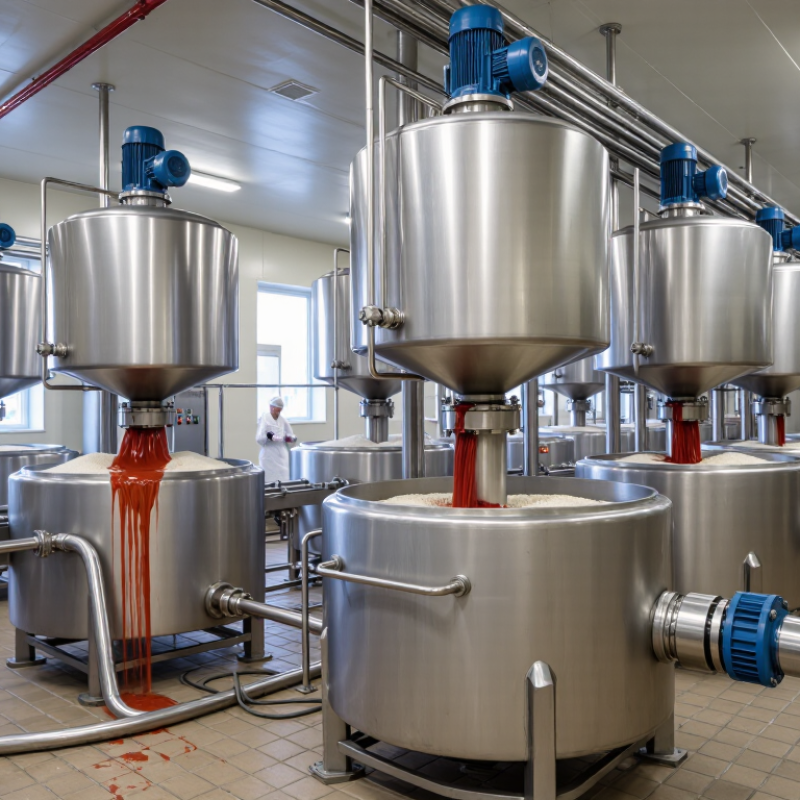
Food mixing tanks are sanitary vessels designed to combine ingredients, suspend solids, and control product temperature. Liquid mixer tanks add mechanical agitation through impellers, paddles, or high-shear heads. Their core job is simple: create a consistent blend without damaging sensitive ingredients. In practice, a tank may handle sauces, dairy liquids, beverages, syrups, or emulsions.
Capacity is only one buying factor. Operators should examine viscosity, batch time, mixing speed, heating needs, and cleaning access. Stainless steel construction, smooth welds, sanitary valves, and clean-in-place capability reduce residue risks. Temperature probes and load cells also improve repeatability. The details matter. A poorly positioned impeller can leave powder at the tank bottom.
Industry demand supports this equipment focus. Fortune Business Insights valued the global food processing equipment market at approximately USD 52.36 billion in 2023. Its report projects growth to about USD 82.13 billion by 2032. Grand View Research also identifies automation and hygienic processing as major market drivers. However, published estimates differ by scope and research method. That deserves caution.
From field experience, the best tank is not always the largest or fastest. Excessive shear can damage texture, while weak agitation creates uneven batches. Engineers should test the real product, not only water. A supplier’s technical documentation should include mixing trials, power requirements, surface finish, and cleaning validation details. Ask difficult questions. Small omissions become expensive production problems.
It is a sanitary vessel for combining ingredients, suspending solids, and controlling temperature. It may process sauces, dairy liquids, beverages, syrups, or emulsions. The goal is a consistent blend.
A motor drives an impeller, paddle, anchor, or high-shear head. The selected agitator moves ingredients through the tank. Poor positioning can leave powder at the bottom.
Check the working volume, not only the total capacity. Leave enough space for mixing, foam, and thermal expansion. A larger tank is not automatically better.
Anchor or scraped-surface mixers suit thick products that may stick to heated walls. Paddle mixers provide gentler movement for fragile ingredients. High-shear heads disperse powders and create smooth emulsions. The wrong choice can damage texture.
A jacketed tank heats or cools products through the vessel wall. It supports sauces, dairy blends, syrups, and liquid fillings. Temperature probes improve repeatability. Heating can still be uneven if mixing is weak.
Look for smooth welds, polished internal surfaces, sanitary valves, and full drainage. A surface roughness near Ra 0.8 micrometers is commonly specified. Clean-in-place coverage should be demonstrated, not merely promised. Small crevices matter.
Request material certificates, weld maps, passivation records, and cleaning validation data. Ask for mixing trials using the real product. Documents should state power needs, surface finish, and viscosity limits. Water testing alone is insufficient.
Inspect the tank bottom, outlets, gaskets, valves, and agitator clearance. A flashlight can reveal residue traps near welds. Require factory tests for uniformity, leakage, noise, and emergency stops. Specifications can still miss practical weaknesses.
Viscosity affects motor power, mixing time, and agitator design. Excessive shear may damage particles or product texture. Weak agitation may create uneven batches. Test the hardest recipe. Not water.
In 2026, selecting the right Food Mixing Tank Liquid Mixer Tank requires a clear understanding of its purpose, construction, and operating requirements. Food mixing tanks are designed to blend, dissolve, heat, cool, or hold food-grade liquids and semi-liquid products while maintaining consistent quality. Common types include jacketed tanks, high-shear mixers, agitator tanks, and sanitary storage vessels, each suited to applications such as beverages, sauces, dairy products, and prepared foods.
When evaluating suppliers, buyers should prioritize hygienic design, corrosion-resistant materials, reliable sealing, effective mixing performance, and compliance with applicable food-safety standards. Supplier selection should also consider engineering capabilities, automation options, customization, testing, documentation, delivery reliability, and after-sales support. Proper installation, routine cleaning, preventive maintenance, and operator training can improve equipment lifespan and reduce downtime. Finally, total cost should include energy use, spare parts, maintenance, installation, and long-term operating efficiency rather than focusing only on the initial purchase price.
