
Choosing among China’s best Homogenizer Emulsifying machine manufacturers requires more than comparing polished websites. A reliable decision depends on engineering evidence, practical testing, and transparent communication. Buyers should examine rotor-stator design, pressure capability, contact materials, batch volume, temperature control, and cleaning procedures. A machine that looks impressive may still produce inconsistent droplets during demanding production.
Food colloid scientist Dr. David Julian McClements has written, “Emulsions are thermodynamically unstable systems that are kinetically stable.” This principle matters when evaluating Homogenizer Emulsifying equipment. Manufacturers should explain how their machines reduce droplet size, improve distribution, and maintain stability under real operating conditions. Strong suppliers can provide test records, application data, technical drawings, and references from comparable industries. Stainless steel grade and seal quality also deserve close attention, especially in cosmetic, pharmaceutical, and food production.
The strongest manufacturers usually combine factory experience with responsive engineering support. They can discuss shear rate, viscosity, residence time, and scale-up without hiding behind vague promises. Ask for a sample trial using your actual formula. Watch the operator load the vessel, adjust speed, and inspect the final texture. Small details matter. A smoother cream, fewer air pockets, and easier cleaning can affect daily costs significantly.
Still, no supplier is perfect. Buyers may overvalue price, appearance, or one successful demonstration. That mistake is easy to make. A careful comparison should include warranty terms, spare-part availability, installation guidance, and after-sales response times. This guide reviews leading China-based manufacturers through those practical criteria, while recognizing that the “best” choice depends on formulation, capacity, compliance needs, and long-term production goals.
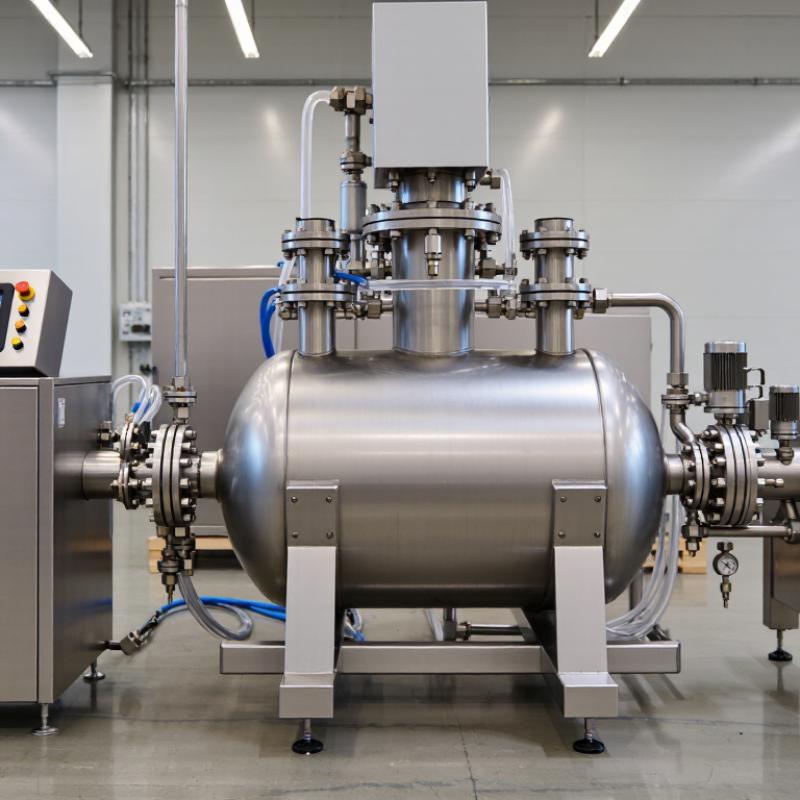
A homogenizer emulsifying machine reduces droplets and particles through intense mechanical force. It creates a more stable mixture of oil and water. High-pressure models push liquid through a narrow valve. Rotor-stator models use fast-moving blades and a stationary screen. Both designs can improve texture, color, and storage stability.
In a production line, pressure, temperature, feed rate, and processing time matter greatly. A 2024 market analysis by Grand View Research reported continued growth in the global homogenizer market, driven by food, pharmaceutical, and cosmetic production. MarketsandMarkets also identified rising demand for fine-particle dispersion and consistent product quality. These figures show commercial interest, but they do not guarantee performance. A machine may produce a smooth cream at laboratory scale, then struggle with a thick batch. That gap deserves honest testing.
Tips: Ask manufacturers for verified particle-size data, not only attractive photos. Request a sample trial using your actual formula. Check whether the working chamber is easy to clean. Record inlet temperature, outlet temperature, pressure, and energy use. Stainless steel construction helps, but surface finish and seal design matter too. Do not select capacity by tank volume alone. Viscosity can change everything.
| Evaluation Dimension | Technical Reference | Why It Matters |
|---|---|---|
| Definition | A homogenizer emulsifying machine uses high shear, pressure, or both to disperse one phase into another and reduce droplet or particle size. | It improves uniformity, texture, stability, and appearance in emulsions and suspensions. |
| Main Processing Principle | Rotor-stator machines generate intense local shear; high-pressure homogenizers force liquid through a narrow valve or interaction chamber. | The suitable principle depends on viscosity, target particle size, throughput, and heat sensitivity. |
| Typical Applications | Creams, lotions, ointments, sauces, mayonnaise, dressings, beverages, dairy products, pharmaceutical suspensions, and laboratory formulations. | Different products require different shear intensity, residence time, temperature control, and cleaning procedures. |
| Common Machine Configuration | Batch vacuum homogenizer, bottom-entry rotor-stator mixer, inline homogenizer, or high-pressure homogenizer. | Batch systems are flexible for varied formulas, while inline systems support continuous and repeatable production. |
| Typical Batch Working Volume | Laboratory units: approximately 0.1–10 L; pilot units: approximately 10–200 L; production systems: commonly above 200 L. | Actual capacity depends on vessel geometry, minimum operating volume, formulation viscosity, and required headspace. |
| Typical Rotor Speed | Many rotor-stator systems operate over a variable range of approximately 1,000–6,000 rpm, depending on scale and design. | Higher speed generally increases shear but may also increase aeration, heat generation, and wear. |
| Particle or Droplet Size | Rotor-stator processing can commonly produce submicron-to-micron dispersions; high-pressure processing may achieve finer and narrower distributions for suitable liquids. | The final size is formula-dependent and must be verified using an appropriate particle-size measurement method. |
| Viscosity Suitability | Rotor-stator mixers handle low-to-medium viscosity products; anchor or sweep agitators are often added for high-viscosity creams and pastes. | The homogenizer alone may not provide sufficient circulation in highly viscous products. |
| Vacuum Function | Vacuum processing removes entrained air and can reduce oxidation, foaming, and visible bubbles in creams and emulsions. | Vacuum is useful when appearance, density, oxidation control, or deaeration is important. |
| Temperature Control | Jacketed vessels can provide heating and cooling; processing temperatures are selected according to the formulation and product sensitivity. | Shear energy can raise product temperature, which may affect viscosity, fragrance, active ingredients, or emulsion stability. |
| Product-Contact Materials | Food, cosmetic, and pharmaceutical equipment commonly uses stainless steel such as 304 or 316/316L, selected according to chemical compatibility. | Material selection affects corrosion resistance, cleanability, product safety, and service life. |
| Cleaning and Sanitation | Equipment may be designed for manual cleaning, clean-in-place procedures, or a combination of both; seals, valves, and dead spaces require special attention. | Cleanability is essential for preventing cross-contamination and maintaining consistent product quality. |
| Drive and Control | Variable-frequency drives allow speed adjustment; advanced systems may record speed, temperature, vacuum level, time, and batch parameters. | Adjustable and recorded parameters improve process repeatability and scale-up control. |
| Key Selection Criteria | Product viscosity, batch size, target particle size, throughput, temperature sensitivity, vacuum requirement, materials, cleaning method, and applicable regulations. | A machine should be selected from process requirements rather than motor power or nominal vessel volume alone. |
| Performance Verification | Verify particle-size distribution, viscosity, stability, temperature profile, batch uniformity, cleaning results, and production throughput using the actual formulation. | Factory specifications provide a starting point; application testing confirms whether the machine meets the required process outcome. |
Note: The values shown are general engineering reference ranges. Actual performance varies with formulation, equipment geometry, operating conditions, and process validation.
It breaks droplets and particles into smaller sizes through intense mechanical force. This creates a more stable oil-and-water mixture. It can improve texture, color, and storage stability. Results still depend on the formula.
High-pressure models force liquid through a narrow valve. Rotor-stator models use fast-moving blades and a stationary screen. Both designs reduce particle size, but their processing effects differ. Test the actual product.
Pressure, temperature, feed rate, and processing time strongly affect performance. Viscosity also changes how easily material moves through the machine. Record inlet temperature, outlet temperature, pressure, and energy use. Small changes matter.
Request a sample trial using your actual formulation. Measure particle size, viscosity, temperature, batch volume, and power consumption. Run the machine continuously when possible. A polished video proves little. Test it first.
No. Tank volume does not show how the machine handles thick material. A small batch may process smoothly, while a larger batch may struggle. Compare viscosity, feed rate, and processing time. I would not choose capacity from tank size alone.
Ask for verified particle-size data and droplet-size results. Request shear-rate information and continuous-run records. Factory testing should match your viscosity, temperature, and batch conditions. Photos are not evidence. That distinction matters.
Check rotor-stator geometry, pressure control, seal materials, and cleaning procedures. Inspect welding quality, material certificates, cable routing, and gauge readability. Look for accessible seals and a dry testing area. Stainless steel appearance can mislead. I have made that mistake.
Verify certification scope and current audit status. Certification supports quality control, but it does not guarantee stable emulsification. Ask for three comparable installations and spare-parts information. Confirm expected response times after delivery. Service claims need checking.
A Homogenizer Emulsifying machine is industrial equipment designed to blend, disperse, and reduce particle size, producing stable and uniform mixtures from liquids, powders, oils, and other compatible materials. It works by applying high shear, intense turbulence, and controlled circulation to break down droplets or particles and distribute them evenly throughout a formulation. Different designs, including high-shear mixers, vacuum homogenizers, inline systems, and bottom-entry models, can serve applications in cosmetics, food processing, pharmaceuticals, chemicals, and daily-use products.
When evaluating Chinese manufacturers, buyers should consider technical expertise, equipment materials, processing capacity, customization options, quality control, testing services, energy efficiency, delivery reliability, and after-sales support. The best manufacturer is not simply the one offering the lowest price, but the one that can provide a suitable machine for the product’s viscosity, batch size, temperature requirements, and production goals. Clear communication, documented specifications, and practical trials can help ensure a safe, efficient, and dependable investment.
